Law firms
How a law firm can put AI into management without risking what belongs to the lawyer.
In a law firm AI pays off more in management than in drafting: deadline and case-update tracking, replies to the client who asks “how is my case going?”, first drafts and fee follow-up. The rule that organizes everything is to choose the checking by the cost of the error. Anything that could cost a missed deadline, a wrong statement to a client or a breach of confidentiality has a lawyer checking every item; internal, reversible drafts go to sampling. Who decides what the agent may do on its own is always a partner, in writing, before the tool is switched on.
Why management before drafting
The conversation about AI in law usually starts with the brief. It's the worst entry point: the error is costly, checking eats the time the gain promised to save, and a lawyer who already checks everything feels no difference. Firm management is the opposite. It is full of frequent tasks, low risk when well designed, that lawyers do out of duty rather than vocation: checking case updates, updating the client, entering deadlines, chasing documents, reconciling fees.
In a small firm these tasks tend to take between 20% and 30% of the time of people who could be seeing clients, studying the case or winning new work. It's time that shows up on no timesheet, which is why the firm rarely sees it as a cost.
What the agent can do alone, what goes through checking and what is never delegated
The criterion is the cost of the error and whether it can be undone before it reaches someone outside. Applied to a firm, the split looks like this.
Alone, with sample checks: building each case's weekly summary; drafting the client update; reminding clients of pending documents; preparing the fees-receivable report. These are internal draft tasks where an error is cheap and gets fixed before anything goes out. Sorting notices is not in this band: deciding whether a notice carries a deadline is the step that, if it fails, means nobody counts the deadline. So every notice the agent marks “no deadline” is also checked item by item by a lawyer or by the assistant, who keeps reading in parallel. Sampling applies only to what carries no deadline, such as summaries and fees.
With a lawyer checking every item: the computation of any deadline; every progress or document-request message that reaches the client; any document that leaves the firm. Here the agent prepares and the lawyer checks before sending. A message with an estimate, a chance of success or advice does not belong in this band: it is the next section's, and the lawyer writes it.
Never delegated, and the lawyer writes it: case strategy, the decision to file, any communication about outcome or risk, and the ethical assessment of a situation. The agent can gather the material; the decision belongs to the lawyer, who answers for it. Client data also needs its own attention: professional confidentiality applies to whatever is handed to any tool, and choosing the tool and the contract behind it is a partner's decision, not a technical detail.
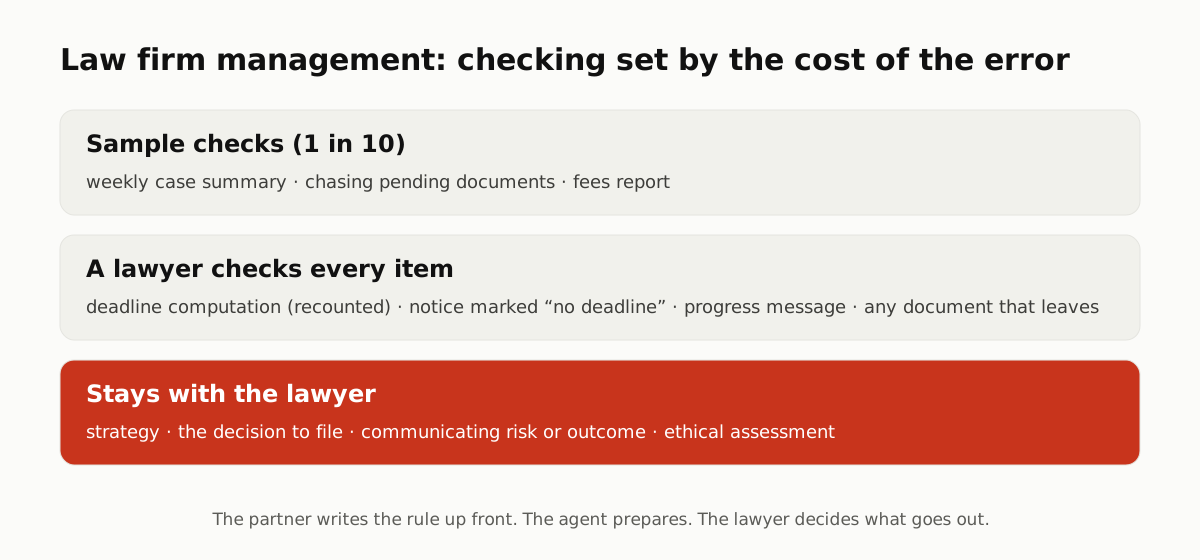
Who decides, who executes and who checks in a firm
Whoever decides is always a partner, and deciding means writing the rule up front: which kinds of client question the agent answers on its own, at what point it hands over to a lawyer, what information it never gives. Whoever executes can be an agent, an assistant or a trainee. Whoever checks is a lawyer, and how often depends on the band the task is in.
The written rule has to be somewhere every agent and every person reads before acting, with who decided and when. In firms the typical mistake is the rule that only exists in the founding partner's head: the agent doesn't know it, neither does the new associate, and each one answers the client differently.
A worked example: an 8-person firm with 140 active cases
A hypothetical example. A civil litigation firm has 3 partners, 3 lawyers and 2 assistants, and 140 active cases. Every morning an assistant spends about 90 minutes reading notices and case updates on the court systems, and each partner gets about 15 client contacts a week asking about progress, each taking 10 to 15 minutes.
- Diagnosis. Over two weeks the firm measures: 90 minutes a day reading notices (about 30 hours a month), 45 weekly client contacts about progress (about 9 hours a week across the three partners) and two near-misses on deadlines in the quarter, both from a notice read late. What is expensive is the deadline, not the reading.
- Plan. The responsible partner writes the rules. The agent sorts each notice by matter and type and flags those containing a deadline; every deadline is computed by a lawyer, who is the one who decides the date, and recomputed by a second lawyer, independently and without seeing the first count, on the day it is entered in the case system. The day before the deadline is only a reminder, because if the first count erred toward a later date, the day before that date is already past the real deadline. The client progress summary is drafted by the agent in plain language and sent by a lawyer: never with an outcome estimate, and never for a matter in which the client is in conflict with the firm.
- Implementation. Two routines, both starting in draft mode: one sorting notices and one writing weekly summaries per client. For the first three weeks the assistant keeps reading the notices, and the aim is to compare what the assistant and the agent flagged. The agent misses two notices with 5-day deadlines out of 210; the missing rule (a notice without the exact case number) gets written.
- Monitoring. At the end of the first month the sorting matches the assistant 98% of the time, and the firm moves to a 1-in-10 sample only for summaries and the fees report, and leaves as they are the item-by-item check of notices marked “no deadline”, the deadline computation and the independent recount at entry. Checking the “no deadline” notices and the weekly summaries (140 cases, about an hour and a half a week) is in the count: the assistant gets back about 18 of the 30 hours a month, spent on filings and documents. Weekly summaries go out without edits in 82% of cases; the other 18% reveal a pattern (cases with a hearing scheduled), which becomes a written rule. Partners' time on progress contacts falls from 9 to 3 hours a week, with the summary checking already deducted, and the deadline stays in a lawyer's hands.
When not to put AI into a firm's management
If the firm has no case management system that serves as a single source (each lawyer keeps deadlines in their own calendar), the first step is to build that source, and no agent solves that. If nobody checks during the first weeks, the rollout skips the step that produces the numbers. If the chosen tool doesn't offer adequate safeguards for clients' confidential data, the gain doesn't justify the risk. And in a one-lawyer firm with 20 cases, reading notices hardly pays for the design.
A firm's communication and advertising have their own professional rules. What an agent drafts for the website or social media is a draft: the lawyer checks it against the applicable bar rules, and responsibility for what is published is theirs.
Where this comes from
I trained as a lawyer. I founded Arbitranet and Justto, two companies that automated legal decisions. Today I run my projects with agents as part of the team. The split on this page is the same one I use there: the agent prepares, a person decides, and checking is proportional to what the error costs.
Frequently asked questions
- How can a law firm use AI in management?
- By starting with frequent, low-cost-of-error tasks: sorting notices and case updates, a weekly summary per case, drafting client updates, reminders for pending documents and a fees report. Deadlines and everything that reaches the client stay with a lawyer checking.
- Can I let AI compute deadlines?
- The agent can point out which notices contain a deadline and suggest a date, but the computation stays with a lawyer, recomputed by a second one, independently, on the day it is entered; the day before is only a reminder. A missed deadline is a costly and irreversible error.
- Who is responsible for what the agent does?
- The lawyer. The agent executes and prepares, but a partner decides the rules and a lawyer checks. Professional responsibility isn't delegated to a tool.
- Is it safe to put client data in an AI tool?
- It depends on the tool and the contract behind it. Professional confidentiality applies to any data handed to a third party, so choosing the tool is a partner's decision, made before the first case.
- Where should a small firm start?
- With the weekly case-progress summary per client, in draft mode, with a lawyer checking. It is low risk, shows the gain within weeks and builds the habit of writing the rules down.