Managing teams with AI
How to run OKRs without them becoming a spreadsheet nobody opens.
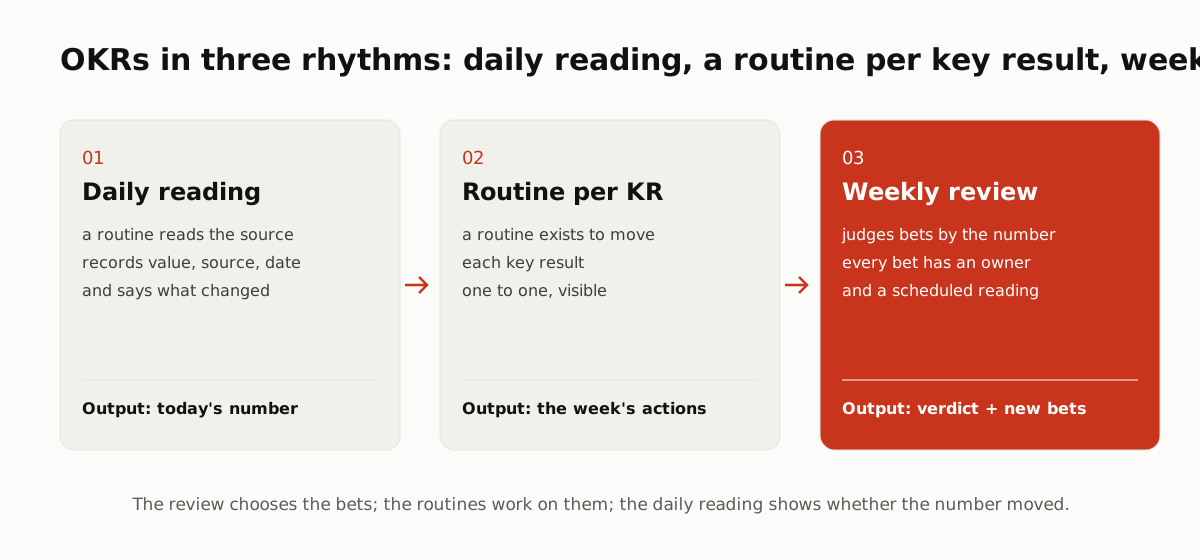
OKRs work when three things happen at different rhythms: someone (or something) reads each key result every day, with a source and a date; every key result has a routine that runs each week for the sole purpose of moving it; and a weekly review judges last week's bets by the number, not by the activity. AI agents make the first two rhythms cheap, and that is what changes: what used to cost a person half-time now costs the decision to write the rule. The third rhythm remains a conversation between people.
Why OKRs die in month two
The pattern repeats. At the start of the cycle the team writes good objectives and measurable key results. In week two someone updates the spreadsheet. By week four the update means fetching the number from three places, and the person who does it is the busiest one. In month two the reading turns monthly, the number arrives late, and the check-in meeting discusses what happened instead of what to do.
The cause isn't a lack of discipline, it's design. A key result with no daily reading is a target you only discover you missed at the end of the cycle. A key result with no routine to move it is a wish: the number only moves if someone remembers to do something for it, and what moves then is the mood of the meeting. And a review that lists what each person did, instead of judging whether the number moved, rewards motion and leaves the result to luck.
Rhythm 1, daily: a reading that doesn't depend on remembering
Each key result has a source for its number (the database, the analytics tool, the bank statement, the calendar) and a routine that reads it every day. The routine records three things: the value, where it came from and when it was read. And it says what changed from the previous reading. Without source and date the number can't be checked; without the comparison it says nothing.
Two rules prevent the most common reading errors. The first: gaps are declared. If the source didn't answer today, the routine writes that it didn't read, instead of repeating yesterday's value. The second: a key result that is behind pace is shown by its number and by what moves it, and is never declared lost before the cycle ends. Writing a KR off in week 6 is a retrospective decision taken too early, and it takes away the only thing an OKR has to give, which is the chance to react while there is still time.
Rhythm 2, weekly: a routine that exists to move each key result
For each key result the design question is: what runs every week, without me having to remember, that changes this number? If the answer is “nothing”, the key result doesn't have an owner yet, it has a wish. If it's “I have to remember to do it”, it depends on the week being a good one.
The routine can be human or agent. For a revenue KR it might be the routine that prepares the list of proposals stalled for more than seven days, with a draft follow-up for each. For a quality KR, the one that reviews a sample of deliveries and notes where the standard slips. Where the number stalls, the routine acts and leaves ready what needs a person. An agent's routine delivers a draft, and a person decides what ships, using the same split of deciding, executing and checking described on the page about who does what when part of the team is an agent.
What matters is that the relationship is one to one and visible: this KR, this routine. When a KR moves you know which routine to credit; when it doesn't, you know which one to change. A routine with no KR is activity, and activity with no effect on the objective is a cost.
Rhythm 3, weekly: the review judges bets, and every bet has an owner
Monday's review doesn't go over tasks. It does two things. First, it judges last week's bets, each with the same card: what was being bet, the starting number, where and when the result would be read, the condition for dropping it, who was doing it, and the verdict: done or not done, moved the number or didn't, and why. Second, it chooses the bets for the week that starts.
A bet is a hypothesis with a short deadline: “if we send the repurchase reminder on day 25 instead of day 40, the 60-day repurchase rate goes up”. It has an owner, a named person who executes it or makes sure someone does, and often an agent that works the whole week to make it succeed. A bet without an owner is an intention. A bet without a scheduled reading is an opinion: nobody knows the following Monday whether it worked.
The verdict “didn't move it” is a result, not a failure. What the team loses is the bet nobody judges, because it comes back next week under another name. A person does the judging; the agent prepares the material (the starting number, today's number, the list of bets) so the conversation spends its twenty minutes on why, not on hunting for data.
A worked example: repurchase at an online store with 12 people
A hypothetical example, in numbers. An online cosmetics store with 12 people and about 4,000 orders a month writes, for the cycle, an objective, “make customers come back”, and a key result: raise the 60-day repurchase rate from 18% to 26% by the end of the quarter.
- Source and reading. The number comes from the order base: customers who made their first purchase 60 days ago and bought again. A routine runs the query every morning at 7, records the value, the date and the cohort used, and writes one line: “19.1%, +0.3 points in 7 days”. The daily reading is a single cohort, the one whose first purchase was 60 days ago, and a one-day cohort is small and noisy. So the value that counts for the key result is the average of the last 30 days of cohorts, weighted by each cohort's number of customers, and the routine's line says which window it used. Near the end of the cycle that window includes ever more recent first-purchase cohorts, and the KR page flags when it changes. On a day the database doesn't answer, it writes “didn't read” and doesn't repeat the value.
- The routine that moves it. The team asks what runs every week that changes this number. The answer is a routine that, every Tuesday, lists customers whose first purchase was 20 to 30 days ago and who haven't been contacted yet, and drafts one message per customer based on the product they bought. The CRM person, who is the one who decides, writes the rules: never offer more than 10% off, never contact anyone with an open complaint. Checking is item by item for the first two weeks and by sample afterwards.
- First bet, with an owner. In Monday's review the bet is: “a message suggesting a refill, on day 25, instead of a coupon, increases the cohort's repurchase”. Owner: Marina, from CRM. Starting number: 19.1%. Scheduled reading, week by week: the message goes out every Tuesday, and every Monday the review reads purchases in the 6 days after the send (Tuesday to Sunday), for last week's cohort, against a 10% control group that doesn't get it. The window is 6 days at every reading, so Monday's reading never depends on days that haven't happened yet. The 60-day repurchase only closes five weeks after the first send (day 25 plus 35 days) and is read then. Condition for dropping it: if at the third weekly reading the gap over the control is under 1 point, the bet goes.
- Judgment. At the first three weekly readings the gap over the control is above 1 point, and the bet continues. Five weeks after the first send the first cohort closes its 60 days: those who got the message repurchase at 24.3%, against 20.1% for the control. The bet moved the number, and the 4.2-point difference is the effect. The 10% discount used on another cohort gave 22.8%, but cost margin. The review decides to keep the refill message, test day 20 and retire the coupon. The KR ends the cycle at 23.4%, below the 26%. The arithmetic: only the cohorts after the first send are at 23.9% (90% treated at 24.3% and 10% control at 20.1%), and the KR blends those with the cohorts before the bet, still around 19%. Close, without pretending it got there, and with an explanation of what moved it.
When not to do this
If the team has fewer than five people and everyone sees the number every day in conversation, a reading routine is ceremony: look at the number and talk. If a key result has no source a routine can read, the first task is to create the source, not to write the OKR. If OKRs are used to evaluate people or calculate bonuses, the team will choose targets that are easy to measure and hard to miss, and the daily reading starts to reward makeup. And if the decision the number was meant to inform has already been made, the daily reading is just noise.
The most common mistake of people starting out is to switch on the daily reading of ten key results at once. Start with two, let the routine deliver for one cycle and only then expand: the first version of a reading always finds a number that doesn't match, and it's better to discover that with two than with ten.
Where this comes from
It is the system I use to manage my own projects. Each key result is read every day by a routine, which records the value with its source and states the gap when the source doesn't answer; there are routines whose only purpose is to move a specific KR; and every Monday a weekly review judges last week's bets by the number and chooses the next week's, each with an owner. It's what I learned managing teams for more than a decade, before and after agents joined the team: management doesn't disappear when part of the work is done by an agent, it starts being done in writing.
Frequently asked questions
- How can I use AI to manage OKRs?
- Give an agent routine the daily reading of each key result (value, source, date and change), the preparation of the weekly review material and the draft of the week's actions. The decisions, especially which bets to make and the verdict on them, stay with a person.
- How often should key results be read?
- Every day, by a routine that doesn't depend on someone remembering. The reading is cheap when automatic, and it's what lets you react in week 4 instead of discovering the failure in week 12.
- What is a bet in the weekly review?
- A hypothesis with a short deadline, an owner and a scheduled reading: what you believe will move the number, the starting value, who executes it, and when and where the result will be read. At the next review it gets a verdict: done or not, moved or not, and why.
- Can I write off a key result before the cycle ends?
- It isn't recommended. A KR behind pace is shown by its number and by what moves it. Judging what was achieved and setting new targets is the job of the end-of-cycle retrospective.
- How many key results should I automate first?
- Two. The first reading always reveals a number that doesn't match its source or a gap; it's cheaper to fix that on two key results than on ten.