In-house legal
How a company's legal department can use agents without becoming a bottleneck or taking on risk.
The in-house legal department has a problem a law firm doesn't: demand comes from inside, in volume and with no organized queue, and the team is judged by how far the company can move without waiting for it. That is why the agent pays off more at intake than in the opinion: triage of requests, a first read of contracts against a standard the legal team wrote, an obligations calendar and reporting to leadership. The rule is the same as in any operation: checking is chosen by the cost of the error. What a business team can sign without a lawyer is the head of legal's decision, written beforehand, and opinions, strategy and risk stay with a lawyer.
The in-house problem: the queue nobody sees
In a company's legal department, requests arrive by email, by chat, in the hallway and in meetings. Each team sends theirs however they see fit, the urgent is always mixed with the routine, and the lawyer spends much of the day deciding what to handle first instead of handling it. Requesters don't know what is ahead of them, and legal becomes, in the company's perception, the place where things wait.
That has a cost that almost never shows in a report: contracts that delay a sale, a hire left hanging, a team that gives up consulting and signs on its own. A legal department's performance is measured by indicators such as response time, volume by type of request and outside-counsel spend, and most of them depend on something the team rarely has: a record of each request with its type, intake date and response date.
Where the agent comes in: at the front door
The best first routine is the one that does triage. Every request starts to come in through a single channel, and the agent classifies it by type (NDA, supplier contract, sales contract, labor question, corporate, other), logs the date, identifies who asked and the stated deadline, and sends the requester a reply saying what is missing to get started. That already solves half the problem, because the team knows what is on its plate and the company knows where its request stands.
The second routine is a first read of contracts against a standard. Legal writes, once, what it accepts, what it accepts with changes and what it never accepts in each contract type: payment terms, liability cap, venue, automatic renewal, data clause. The agent compares the incoming contract with that standard and returns a report of deviations, and the lawyer works on the deviations, not on the whole contract.
What the agent does alone, what goes through checking and what stays with the lawyer
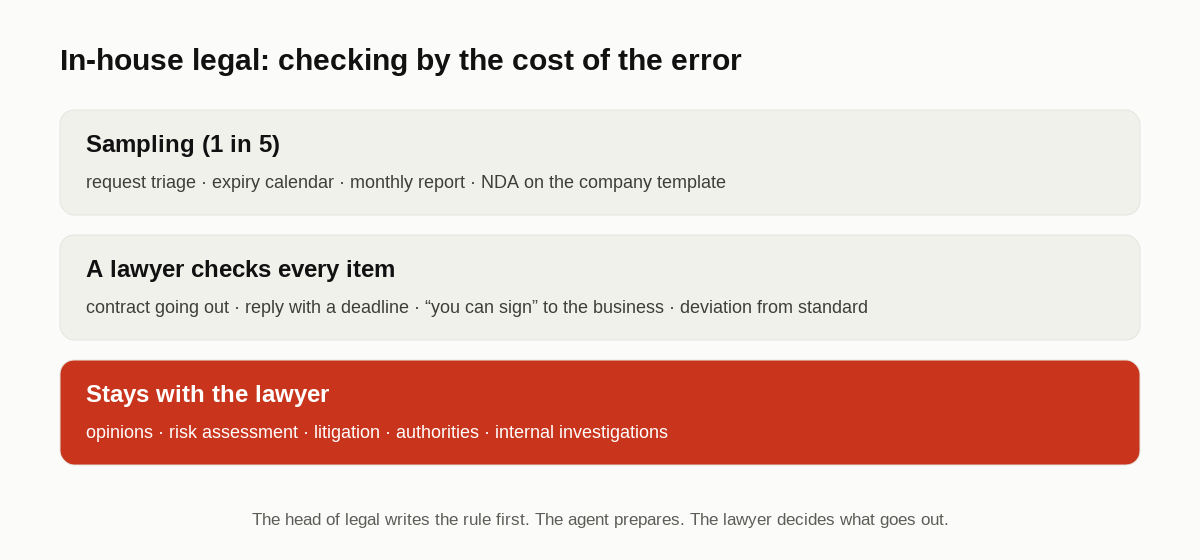
The criterion is the cost of the error and whether it can be undone before it reaches someone outside the company.
Alone, with sampling: classifying and logging requests; telling the requester what is missing; building the calendar of expirations and renewals from the contracts; preparing the monthly report of volume and response time. In all of this the error is cheap and gets fixed inside the company.
With item-by-item checking by a lawyer: any contract or amendment that goes to the counterparty; any reply on a legal or contractual deadline; any answer back to the business team that says “you can sign”. The agent prepares and the lawyer checks before it goes out. The only exception is for what the head of legal has written down: a standard NDA, on the company's template and unchanged, can be checked by sampling.
Stays with the lawyer, and the lawyer writes it: opinions, risk assessment, litigation strategy, replies to notices or authorities, internal investigations and anything under professional privilege that shouldn't pass through a tool without an adequate contract. The agent can gather the material; the decision and the signature belong to whoever answers for it.
Who decides, who executes and who checks
Whoever decides is the head of legal, and deciding means writing beforehand what the business can do without a lawyer: a standard NDA up to a certain value, a supplier contract below a limit and within the standard, a renewal without changes. Whoever executes can be an agent, an analyst or a trainee. Whoever checks is a lawyer, at a frequency set by the task's band.
The contract standard, the limits and the exceptions live in a document the agent and the people read before acting, with who decided and when. Without it, each lawyer answers the business differently, the agent learns the style of whoever used it last, and the company gets contradictory answers from the same department.
A worked example: four lawyers and 35 requests a week
A hypothetical example. A 600-person company has a legal department with a head and three lawyers. It gets about 35 requests a week, by email and chat, and the average response time, which nobody measures, seems to be around three days.
- Diagnosis. For two weeks the team logs each request by type, intake date and response date. The result: 14 of the 35 weekly requests are NDAs, 9 are supplier contracts, 6 are sales contracts, 4 are labor questions and 2 are other. NDAs take 20 minutes each (about 4.7 hours a week) and 11 of 14 follow the company template unchanged. The real average response time is 4.2 days, and sales contracts are the ones that delay revenue most.
- Plan. The head writes the rules. Every request comes in through a single form. The agent classifies and replies to the requester with what is missing. An NDA on the company template, unchanged, with a term of up to 3 years, goes out with a 1-in-5 sample check; any change goes to a lawyer. Supplier contracts get a written standard of eight clauses, and the agent returns the list of deviations. Sales contracts and any labor matter stay with a lawyer from the start, and the agent only logs and organizes.
- Implementation. Two routines, both starting as drafts: triage, and reading NDAs and supplier contracts against the standard. For the first three weeks the lawyers keep reading everything as before and compare what they saw with the agent's report. The agent lets a foreign-venue clause slip through in 2 of 27 supplier contracts, and the missing rule (venue outside the country is never accepted without a lawyer) is written.
- Monitoring. After a month, classification is right on 96% of requests and the deviation report matches the lawyers' reading on 91% of supplier contracts. NDAs on the company template move to a 1-in-5 sample, and supplier ones keep a lawyer's check, now only on the deviations. Average response time falls from 4.2 to 2.1 days, the lawyers get back about 8 hours a week, spent on sales contracts, and the first monthly report the head takes to leadership already shows volume by type and response time.
When not to put agents into in-house legal
If requests don't go through a single channel, the first step is to create that channel, and no agent solves that. If the department hasn't written its contract standard, the agent compares against a standard that doesn't exist and invents one. If the company has no tool with confidentiality safeguards adequate to the data passing through it, the gain doesn't justify the risk. And in a department with a single lawyer and a few requests a week, automated triage hardly pays for the design.
There are matters the agent doesn't enter at all: internal investigations, dealings with authorities, strategic litigation. Professional privilege applies to everything handed to any tool, and choosing the tool and the contract is the head of legal's decision, not a technical detail.
Where this comes from
I trained as a lawyer. I founded Arbitranet and Justto. Today I run my projects with agents as part of the team. The split on this page is the one I use there: the agent prepares, a person decides, and checking is proportional to what the error costs.
Frequently asked questions
- How can an in-house legal department use AI?
- By starting at intake: a single request channel, triage by type and a first read of contracts against a standard written by legal. Opinions, risk and strategy stay with a lawyer.
- Can the agent tell the business it can sign a contract?
- Only for what the head of legal wrote beforehand, such as an NDA on the company template and unchanged, and even then with a sample check. Any deviation goes to a lawyer.
- What should a legal department measure?
- Response time by type of request, volume by type, rework and outside-counsel spend. All of it requires a record of each request with type, intake date and response date.
- Is it safe to run company contracts and data through an AI tool?
- It depends on the tool and the contract behind it. Confidentiality applies to any data handed to a third party, and the choice is the head of legal's decision, made before the first contract.
- Where should we start?
- With the single request channel and triage, in draft mode, with a lawyer checking. It is low risk and already shows the real response time, which almost no team has measured.