Product
Building got cheap. Validating didn't, and that is where most teams get lost.
When a working prototype takes days, the risk stops being “can we build it?” and becomes “will someone outside the team use it, come back and pay?”. The most common mistake of the AI era is confusing a built product with a validated hypothesis. I validate like this: I write the hypothesis as behavior by people who are not on the team, design the smallest test that shows that behavior, write down before looking at the number the threshold that makes me continue, change or stop, and only then read the result. Flattering opinions don't count; repeat use and payment do.
What changed: the cost of building fell, the cost of building for the wrong audience didn't
Building a product used to cost months, and that cost worked as an involuntary brake: nobody spent six months without first talking to a few people. With agents writing code, an impressive prototype takes a week. The brake is gone, and so is the conversation that came with it.
The result is a common pattern: the team builds, shows friends and colleagues, hears “this is cool” and concludes it validated. But “this is cool” is a reaction to a demo, not a decision to use it every day, let alone to pay. Building cheaply doesn't shorten the road to the first paying customer; it only gets you faster to where the real road starts.
There is a hidden cost too: every feature the AI builds in an afternoon goes into the product, and the product grows in every direction without anyone deciding who it is for. The more the product grows before the test, the harder it is to know which part produced the use, or its absence.
Step 1: write the hypothesis as the behavior of outsiders
“Law firms will like the tool” is not a hypothesis, because nobody can show it wrong. The form I use has a subject, an action and a deadline: “at least 6 of 20 firm managers who receive the prototype will enter their first case within 7 days, without my asking more than once”. You can count it, you can be wrong about it and you can read it without interpreting.
The subject has to be outsiders: people who owe the team no favors, don't work with it and gain nothing by being kind. Friends validate friendship. The control question is simple: if the number comes in good, would I accept it from a stranger? If not, the hypothesis is measuring the wrong person.
Step 2: the smallest test that shows that behavior
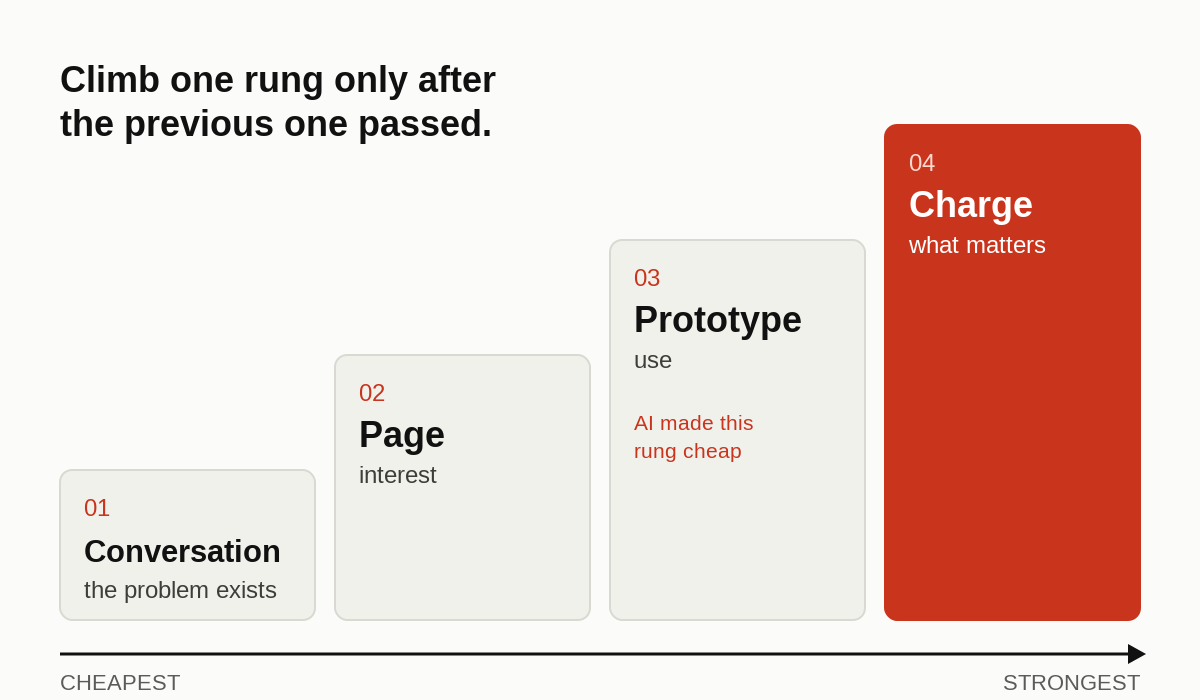
The right test is the cheapest one that still forces the person to do the real thing. In ascending order of strength: a conversation in which the person describes the last time they had the problem (weak but cheap); a page describing the offer with a button that leads to a sign-up (measures interest); a prototype the person uses with their own data (measures use); and a charge, even a symbolic or advance one (measures what matters).
The rule is to climb a rung only once the previous one has passed. AI helps at the right rung: it makes the prototype usable with real data cheap, which used to be expensive. But it doesn't replace the charging rung, which depends on a person deciding to put money down. A payment test can be as simple as asking for 50% upfront on a 30-day pilot.
Step 3: the threshold written before looking at the number
This is the step most often skipped and the one that protects most. Before running the test I write three numbers: what would make me continue, what would make me change the hypothesis and what would make me stop. “Continue: 6 or more of 20. Change: 2 to 5, and then I need to understand who activated and who didn't. Stop: fewer than 2.”
Without a written threshold, any result becomes an argument in favor. Three of 20 becomes “a promising start”; zero of 20 becomes “the audience hasn't understood yet”. The threshold written first is what stops us negotiating with our own number. It is the same logic as the bet with an abandonment condition that I use in OKR management: the bet has an owner, a deadline and the reading that makes it stop.
How the bet with an abandonment condition fits into management
Step 4: read the result separating use from praise
When reading, I separate four things that usually arrive mixed. Praise (said they liked it), intent (said they would use it), use (did the action) and return (came back unprompted). Only the last two go on the scoreboard. Someone who entered a case and never opened the product again is use without return, and counts as half a point, not one.
I also look at who activated, not just how many. If the 4 who used it are the same kind of customer, the hypothesis may be right for a smaller audience than I imagined, which is a valuable result, not a failure. And I record what people did, not what they said: the screen they opened, the point where they stopped, the question they sent me.
A worked example: a contract-checking tool for in-house legal departments
A hypothetical example. A three-person team builds, in ten days with agents, a tool that reads supplier contracts and flags clauses outside the company's standard. The prototype works and the demo impresses. The question is whether legal departments will use it and pay.
- Hypothesis. “At least 5 of 25 heads of legal who get access will upload a real company contract within 10 days, and 3 of them will accept a paid pilot at US$300 a month.” The subject is outsiders, reached through second-degree contacts, not friends.
- Test. Instead of opening a public sign-up, the team offers access to each head of legal by a short message, and asks them to upload a real contract, with sensitive data swapped for placeholders if needed. The charge is part of the same test: whoever uploaded a contract receives, at the end of the period, an offer of a paid pilot.
- Threshold written first. Continue: 5 or more of 25 use it and 3 accept to pay. Change: 2 to 4 use it, and the team investigates what those who used it have in common. Stop: fewer than 2 use it, or nobody accepts to pay.
- Reading. In 10 days, 7 of 25 uploaded a contract and 3 came back a second time; two said the tool is “great” but never opened it again. The 3 who came back are all from companies of 200 to 800 people with 2 to 4 in-house lawyers, and none accepts to pay US$300: two ask for the tool inside the contract of other software they already pay for, and the third says the purchase decision belongs to finance.
- Decision. The use number passed the continue threshold, but the payment number fell in the change band. The team doesn't keep building features; it changes the price and channel hypothesis (a module inside a platform the audience already pays for, or a sale to finance with ROI in hours) and runs another 10-day test with that audience. Two weeks of work avoided months of building on a price nobody accepted.
When this kind of validation doesn't apply
When the product is an internal tool for your own team, validation is you using it for two weeks and counting how often you came back. When the market is so small that there aren't 20 people to test with, the test becomes a series of long conversations, one person at a time, and the hypothesis is written accordingly. And when the product only has value with many people already in (a network, a two-sided marketplace), the smallest test isn't the product, it's proof that one of the sides shows up.
It is also no excuse never to build. Validating is reducing the risk of building the wrong thing, not postponing the build. If the cheapest test is already the product, build it.
Where this comes from
I founded Arbitranet and Justto, and today I run my projects with agents as part of the team. In the products I build, what gets measured is use by outsiders, and each week's bet has an owner, a deadline and an abandonment condition written before the reading.
Frequently asked questions
- How do you validate a product built with AI?
- Write the hypothesis as the behavior of outsiders, pick the smallest test that forces that behavior, write the continue, change and stop thresholds first, and only then read the result. Count use and return, not praise.
- Is prototyping fast with AI already validating?
- No. The prototype shows it can be built. Validating is showing that an outsider uses it, comes back and pays. Cheap building only brings forward the moment validation has to start.
- What is the smallest payment test?
- Asking for an advance charge, even partial, on a short pilot. One person who put money down gives more information than ten who said they would buy.
- Why write the threshold before seeing the result?
- Because without it any number becomes an argument in favor. A threshold written first stops you negotiating with your own result.
- How many people do you need to validate?
- To decide continue, change or stop, 15 to 30 people from the right audience usually suffice. It isn't a statistical sample: it is enough to see a pattern in use and recognize who activated.